Carlos Revilla
L'EVOLUTION DU SURREALISME
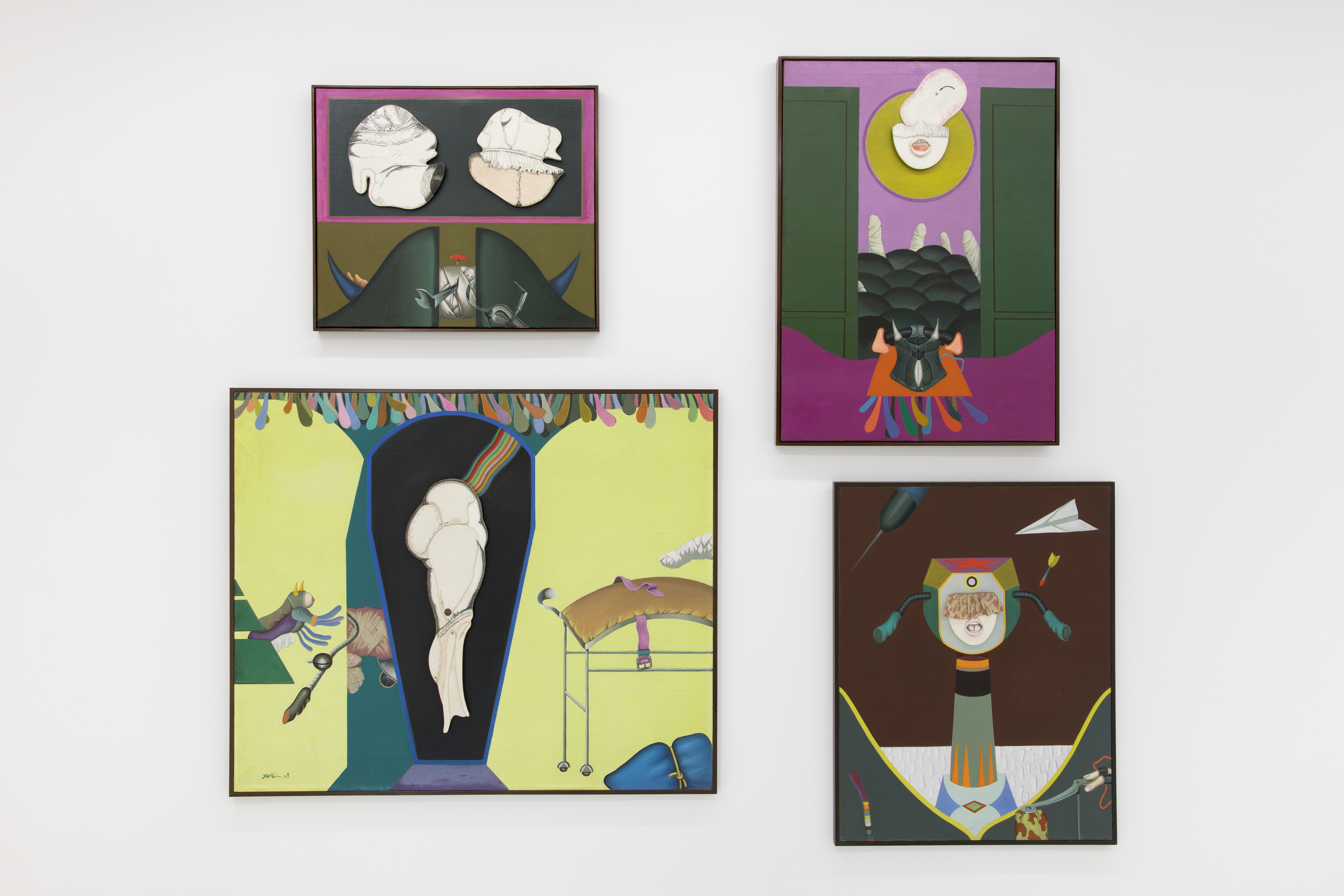
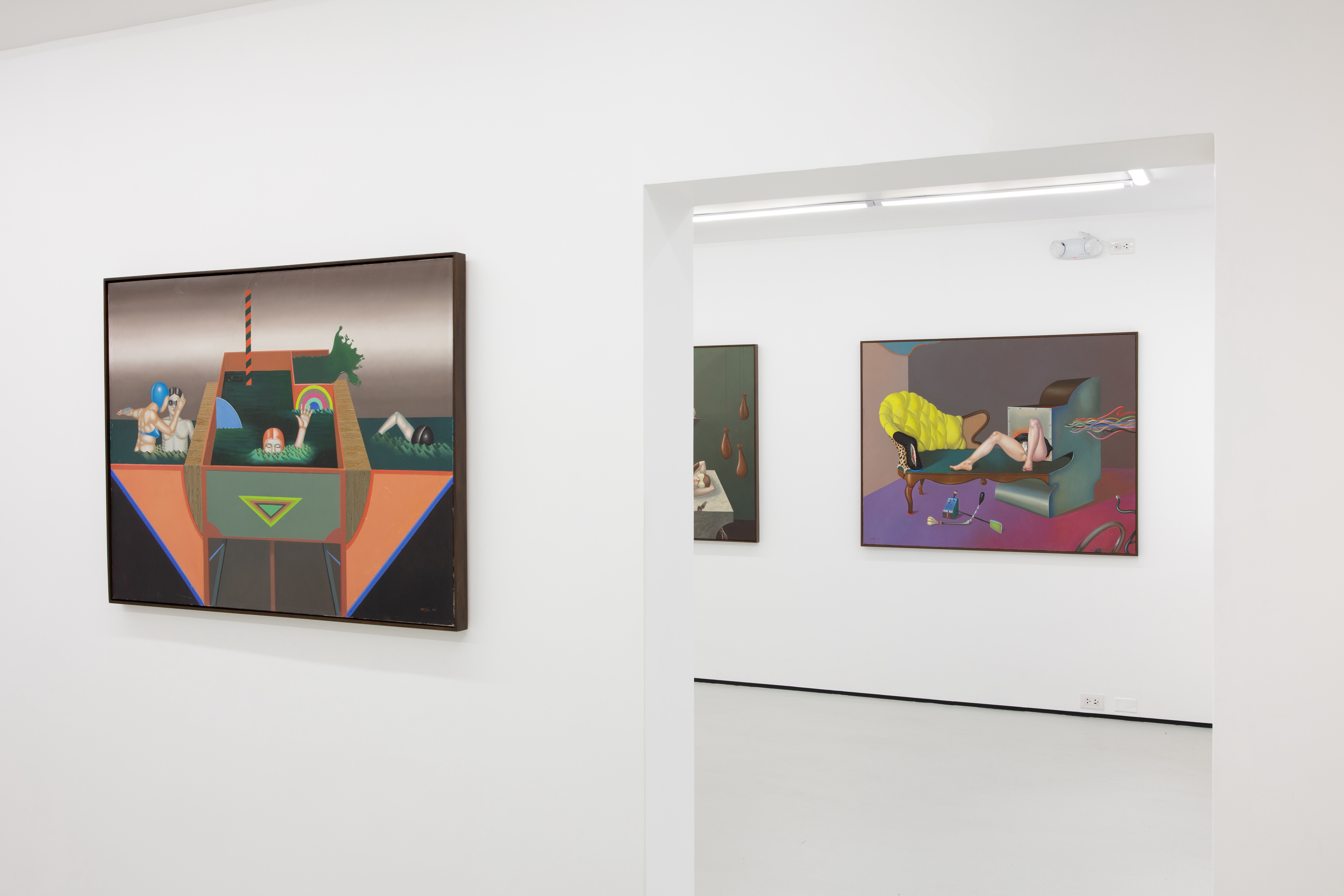
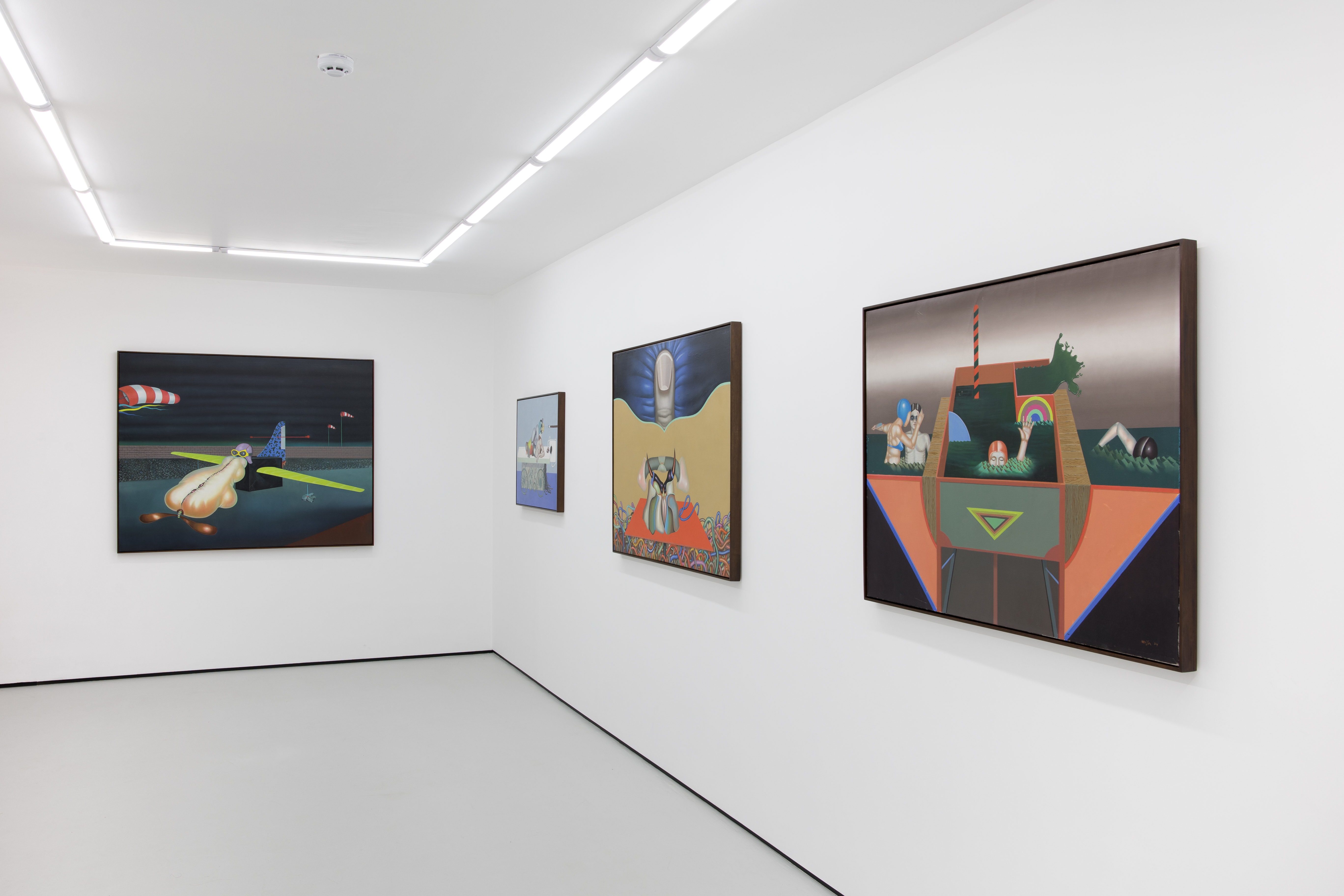
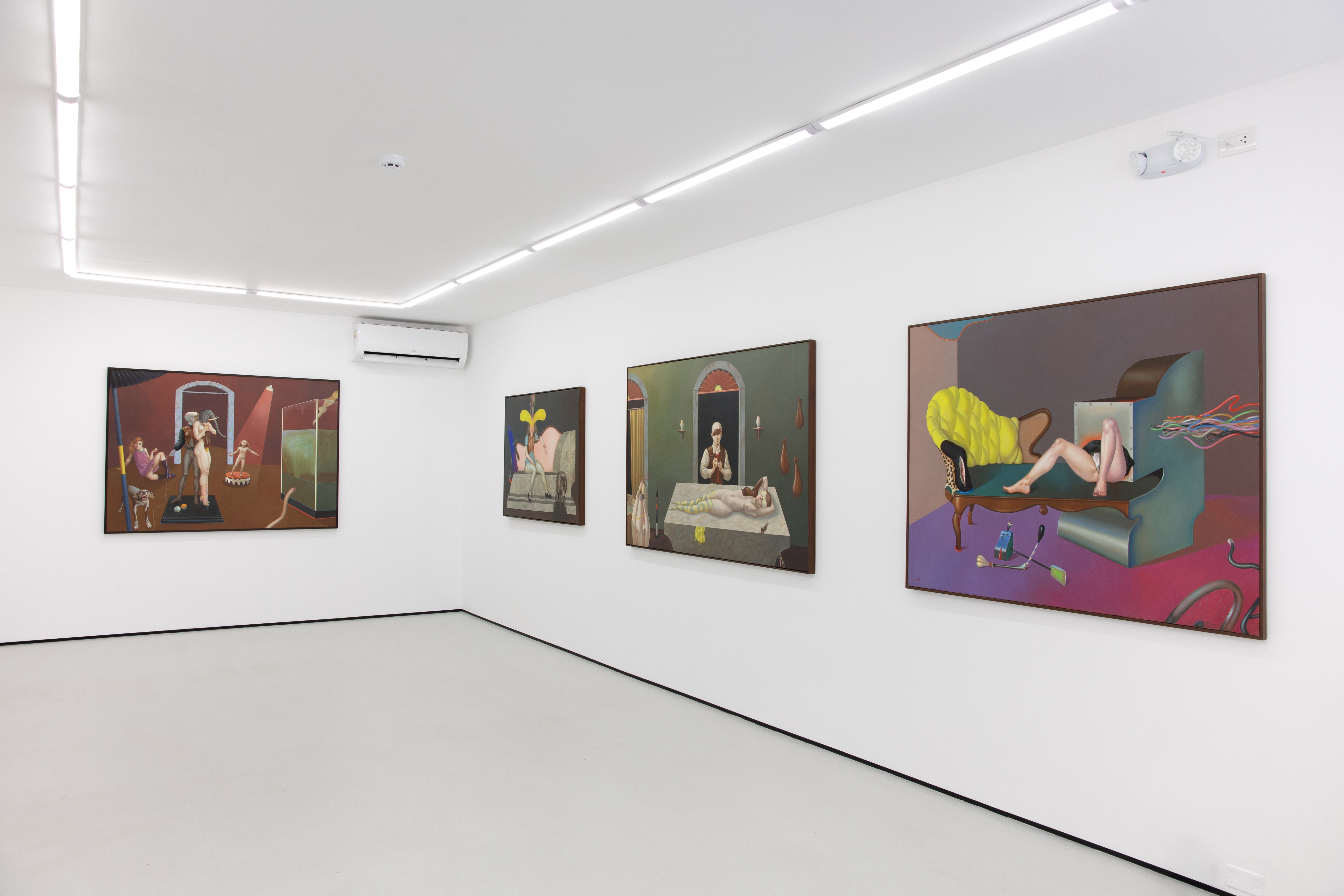
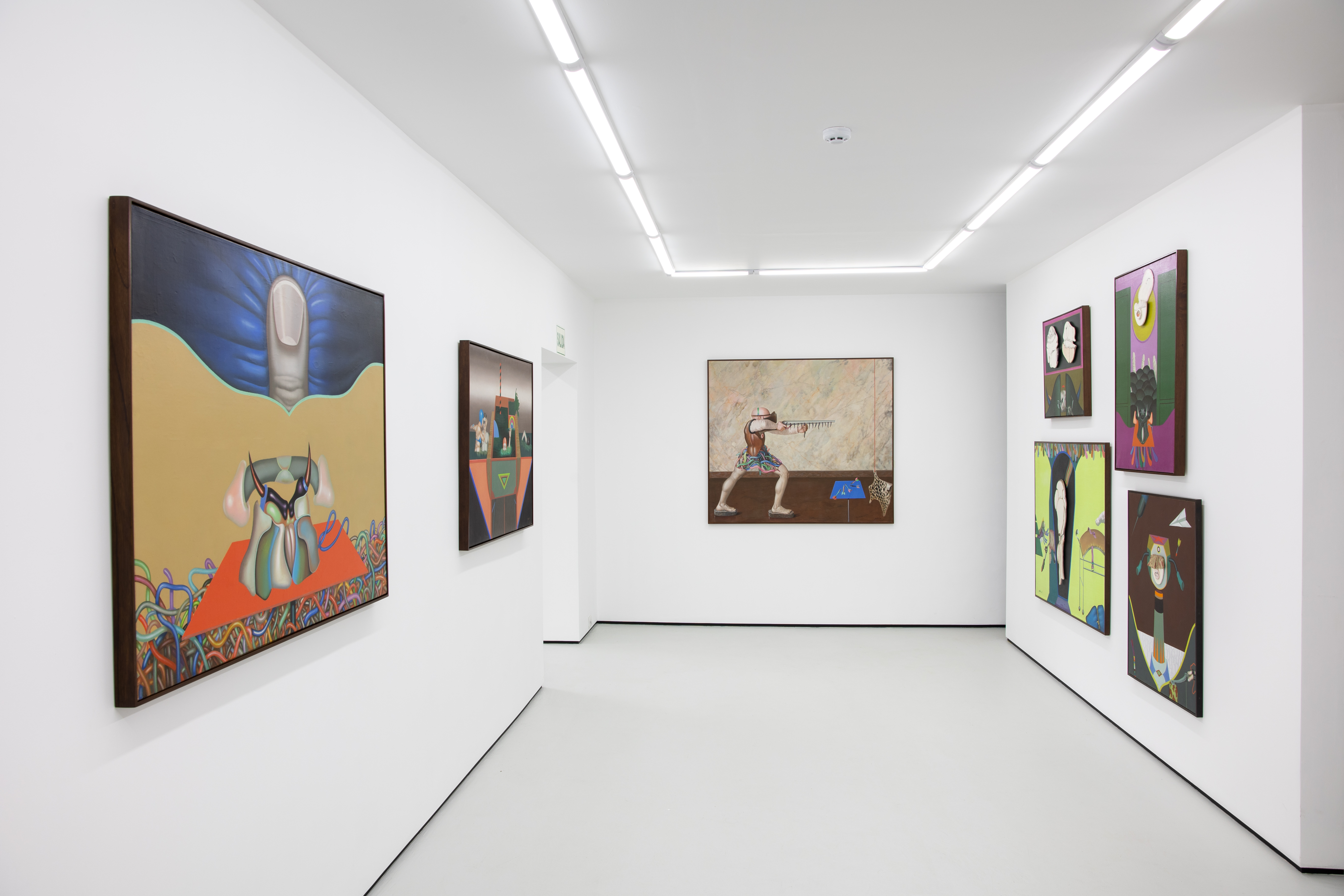
Carlos Revilla (1940-2022), a great Peruvian visual artist, played a unique role in the renewal of surrealist art in Europe after the death of André Breton, the leader of French surrealism, in 1966. He did so from 1967, first in Italy and then in Belgium, where in 1972 he met the writer Edouard Jaeguer, founder of the Phases group, a new core of Belgian surrealism that stood firm in its sober dissent from the French movement (which had been officially dissolved in 1970). Revilla’s adherence to surrealism was nurtured by this key connection, and over the next 15 years, it manifested in a succession of paintings born from a disturbing vision—acidic, skeptical, and erotic—colored by a new world of synthetic materials and emotions. Revilla’s work challenged the essentially optimistic spirit of the 1960s in industrialized nations, which were marked by projections of unlimited progress and a faith in technology, clearly evident in space travel and intelligent machines—the precursors of today’s artificial intelligence. Between 1968 and 1988, the artist focused his energy on a critical artistic endeavor: the creation of images that aspired to be icons of a new era of uncertainty, lived under the dual specter of lost freedom and dehumanization. In this process, he adopted various techniques from surrealism’s historical avant-garde, blending respect and skepticism in a uniquely constructive way. Thus, he revisited the territories explored by Max Ernst and Paul Delvaux, as well as those envisioned by Salvador Dalí and René Magritte—each in their own manner—and, after precisely recognizing those realms of imagination, he embarked on the realization of a new surrealist painting. His journey began with a detailed reexamination of assemblage (a term loosely translated as "assembly"), without abandoning the flat canvas. Thus, in his Italian awakening from 1967 to 1969, Revilla transitioned from an initial biomorphic painting style to compositions that incorporated extra-pictorial elements as integral parts of the artwork. These elements sometimes took the form of clearly movable arms and legs—extensions of painted figures. These articulated limbs, often enhanced with additional painting, evoked dolls as toys but also suggested mannequins and even automatons. Some compositions featured possible amalgamations of mechanical components and organic elements with anthropomorphic presence. The bolts frequently used to attach these additional elements to the painting’s surface immediately evoked an assembled object. The appeal of these early, novel surrealist works earned the artist awards and mentions in European painting competitions around 1970. His flying machines, entirely painted—almost insect-like airplanes—were among the first memorable works of the 1970s, offering caustic vignettes on progress and industrial power. The works that followed would provoke an even stronger response, as their critical nature became increasingly charged with black humor and transgression. Painting became the stage where Revilla installed his imaginary world of senselessly behaving characters—perhaps engaged in bizarre rituals with a strong erotic undertone. Prosthetics appeared (sometimes suggestive of sex toys), along with strange machines that could be linked to the “bachelor machines” of French artist Marcel Duchamp, updated for modern times, but also resembling the “soft machines” of American writer William Burroughs. The fascination of a Revilla painting is deeply tied to the fact that one is witnessing a moment in a narrative that is irreducible and defies description. Moreover, the storyline remains untellable: the viewer can only know what the artist presents in the painting and is acutely aware of the impossibility of imagining what happened before or what will unfold next. In some cases, what is depicted belongs to an eroticism of transgression, without beginning or end. Within the broader context of European painting, the Peruvian artist also participated in a historical reassessment of tradition, which led to intense appropriationism, among other artistic strategies. In his 1970s paintings, Revilla practiced this approach with restraint but did not hesitate to provoke evident friction—such as when he appropriated the imagined portrait *Napoleon at Fontainebleau, March 31, 1814*, painted in 1845 by the renowned French academic artist Hyppolite Paul Delaroche (1797-1856). His decision to openly feminize Napoleon was a caustic commentary akin to a “repudiation of the father,” in the wake of May 1968 and in response to the emergence of the European Common Market. Mass culture was not foreign to any artist in 1970s Europe, following the explosion of pop art in the previous decade, led by Roy Lichtenstein and Andy Warhol. One might well ask about the influence Warhol’s silkscreened colors had—for example, his iridescent portrait of Marilyn Monroe from 1964. What certainly impacted Carlos Revilla was the photography of Guy Bourdin and Helmut Newton, who in the early 1970s began publishing increasingly audacious fashion editorials in the French edition of *VOGUE*, the ultimate fashion reference of the decade. Bourdin and Newton’s fashion photography was characterized by dark erotic undertones in their mise-en-scènes, sometimes with unmistakable sadomasochistic allusions. They, in turn, had been influenced by *Belle de Jour*, Luis Buñuel’s 1967 film starring the stunning Catherine Deneuve—flawlessly dressed by Yves Saint-Laurent—as a young, affluent wife who unexpectedly gives in to intensely charged sexual fantasies and turns to prostitution. In Lima during the 1970s, it was impossible to exhibit works as confrontational as Carlos Revilla’s most notable paintings of the time. The cultural policies of the Revolutionary Government of the Armed Forces allowed no space for transgressive art. The works the artist exhibited in local galleries between 1975 and 1977 belonged to his less confrontational series. JORGE VILLACORTA CHÁVEZ, November 2023
Receive more information on available works from this exhibition.
Carlos Revilla
Carlos Revilla (France, 1940 – Lima, 2021) was the son of a Peruvian diplomat and a French mother. His father’s profession, along with his artistic training and career, led him to live in different countries, though he never lost his Peruvian roots. In Spain, he developed strong ties with the Surrealist group, drawing particular influence from Salvador Dalí’s vision of the movement, with whom he shared a close friendship. After André Breton’s passing, he was invited by Eduard Jaguer in Paris to join the *Phases Group*, where he helped organize exhibitions across southern France, Belgium, Germany, and other parts of the region. He remained with the group until the early 1980s. From Surrealism to Magical Realism, Revilla’s work is rich in symbols that reflect his inner world. His paintings are also marked by eroticism and the distinctive presence of the female figure—portraits and forms blending seamlessly with technological elements, organic shapes, or landscapes, all appearing with an uncanny sense of normalcy.